
Authors may authorise the general public to reuse their works for non-profit purposes only, readers may use a work to generate another work, provided that research credit is given, and they grant the publisher the right to first publish their essay under the terms of the CC BY-NC 4.0 licence.

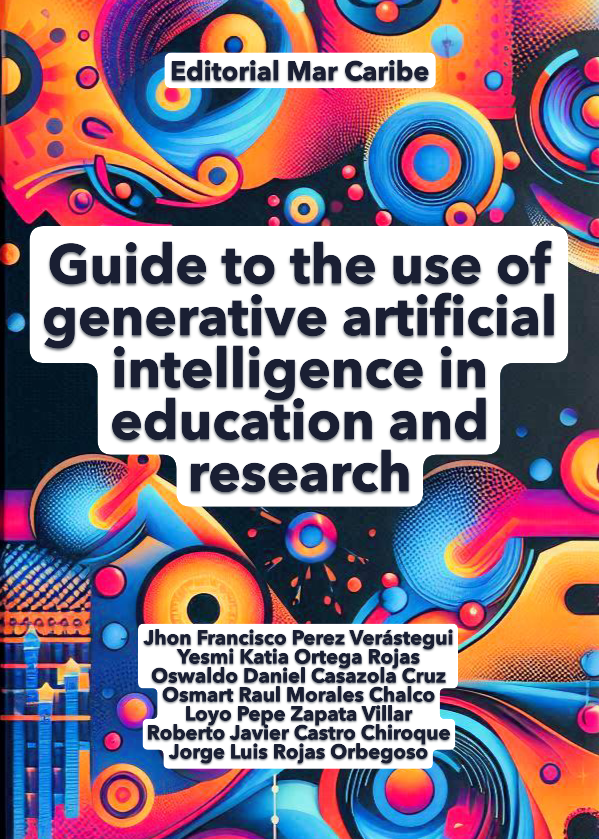
Guide to the use of generative artificial intelligence in education and research
Authors:
Jhon Francisco Perez Verástegui, Yesmi Katia Ortega Rojas, Oswaldo Daniel Casazola Cruz, Osmart Raul Morales Chalco, Loyo Pepe Zapata Villar, Roberto Javier Castro Chiroque, Jorge Luis Rojas Orbegoso
ISBN: 978-9915-698-53-3*
ARK: ark:/10951/isbn.9789915698533
DOI: https://doi.org/10.17613/bf86q-18683
«The advent of Generative Artificial Intelligence (GenAI) constitutes a structural transformation in the architecture of knowledge creation, dissemination, and assessment. Unlike previous technological inflections in academia—such as the digitization of archives or the introduction of Learning Management Systems (LMS)—GenAI does not merely store or transmit information; it synthesizes it. This capacity for synthesis, simulation, and generation presents a paradox that defines the current educational and research landscape: the technology offers unprecedented mechanisms for personalized learning and scientific acceleration while simultaneously destabilizing the traditional pillars of academic integrity, copyright, and verification.»
Jhon Francisco Perez Verástegui
*Enter the URL in your browser «http://isbn.bibna.gub.uy/» and browse books by ISBN
Published: 06/12/2025
Location: Colonia, Colonia, Uruguay
Catalogue ISBN – Uruguay: 978-9915-698-53-3*